Last year, we launched Reachy Mini, a small desktop robot built for human-robot interaction. Since then, more than 10,000 of them have made their way to people around the world. While building Reachy Mini, we kept coming back to another question: what would a small robot look like if its main job was not to stay on a desk and interact with you, but to move through the world?
Microduck came out of that question.
Microduck is a 25 cm tall biped robot with 15 motors, a camera, a small depth sensor, two IMUs, and an articulated beak that can pick up objects. It can walk, sit, crouch, get back up from many common falls, and even roller-skate. It weighs less than 800 g, fits on a desk, and is available for pre-order today for £299 before taxes and shipping.
A different kind of small robot
Microduck is not Reachy Mini with legs.
Reachy Mini was designed around interaction. It sees, listens, speaks, and uses its head and body to communicate. Voice is its primary medium, making it an excellent platform for developing conversational AI, experimenting with vision models, and building expressive human-robot interactions.
Microduck starts from the other side of physical AI: action. How do you teach a robot to move? How do you train a behavior in simulation, transfer it to real hardware, see what went wrong, and try again? What changes when the robot can leave the desk, carry something, fall over, and recover? It is an ideal platform for developers who want to train physical behaviors, experiment with reinforcement learning, and test how AI moves from simulation into the real world.
A simple way to think about the two robots is that Reachy Mini is a platform for AI that interacts, while Microduck is a platform for AI that acts. They share the same philosophy: both should be fun when you first turn them on, approachable when you start coding, and powerful enough to become serious development platforms as your projects grow.
Why we made it small
Learning movement is messy. A robot has to try things, fail, and try again. On a large humanoid, every bad attempt can be expensive, difficult to reset, or simply unsafe to run outside a robotics lab.
Making Microduck small and light changes that experience. A failed behavior usually ends with a little robot on the floor, not a major incident. Its size makes it easier to experiment at home, in a classroom, or on a normal workbench. Self-recovery also means you do not have to pick it up after every failed attempt.
The size helps keep the price and setup manageable too. We want learning about legged movement to be possible without buying a large research platform or having access to a dedicated lab.
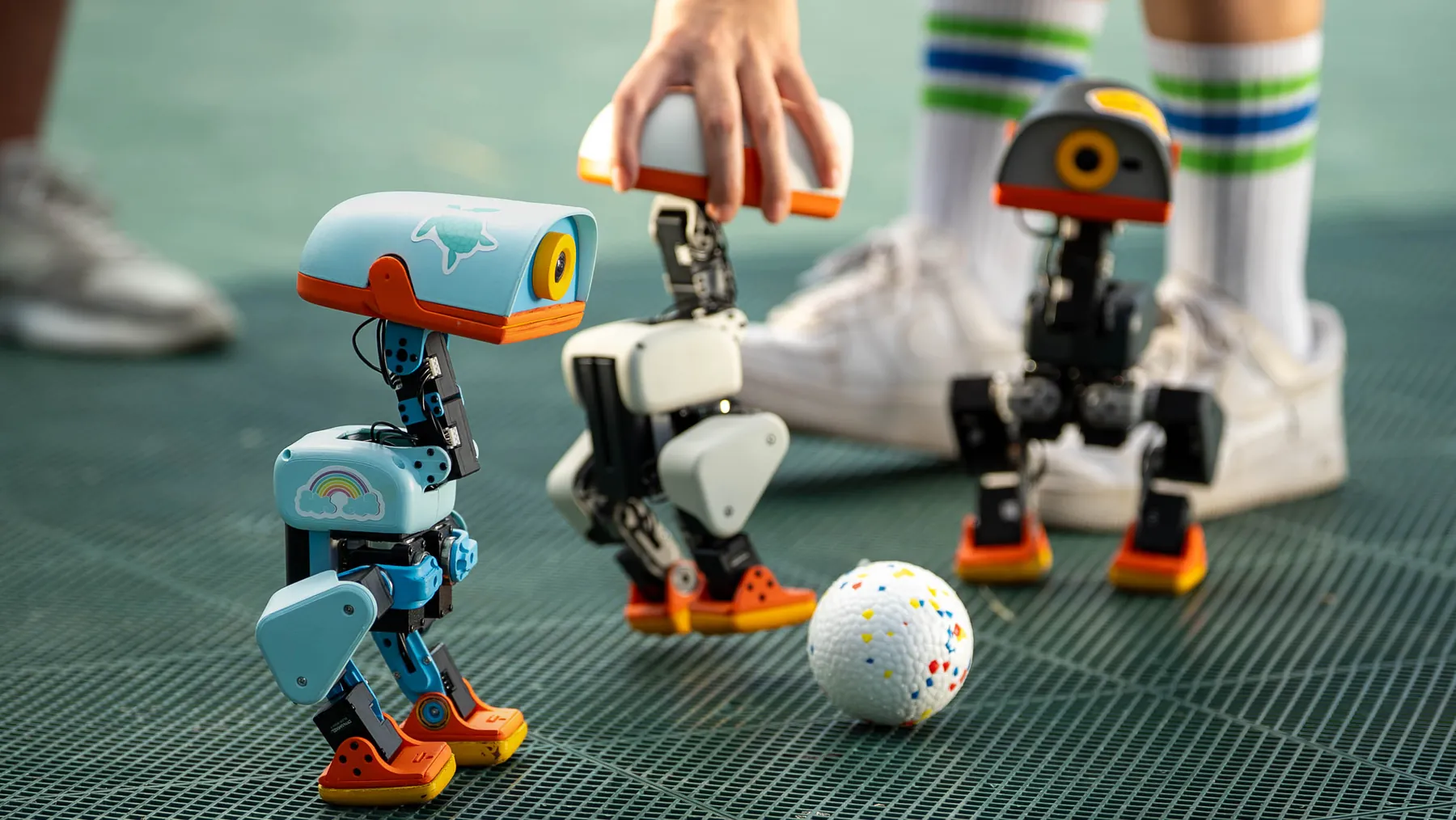
The duck character grew naturally from the robot’s proportions, beak, and waddling gait. We kept it because it makes the robot approachable without hiding the mechanics underneath. It is still clearly a robot, just one that does not take itself too seriously.
Microduck comes in four colorways: Cream, Graphite, Lavender, and Sky. We wanted it to feel lively before it even starts moving, and to make a group of robots look like a collection of different characters rather than identical machines.
Fun first, open underneath
We did not want Microduck to be a development kit that only becomes interesting after a weekend of setup. It comes with learned behaviors so you can start using it straight away. You can make it walk with a gamepad, have it follow a laser dot, trigger movements, or let it react to its surroundings.
Microduck communicates through weird little sounds, closer to a creature than an assistant. Each Microduck gets its own audio identity the first time it wakes up, tied to that individual robot so it keeps the same voice for life.
Its open-source software stack covers robot control, simulation, reinforcement learning, and sim-to-real deployment. The main Microduck repository contains the SDK and robot software, while Microduck RL contains the reinforcement learning and sim-to-real tools.
What we hope happens next
One very unscientific thing we learned internally is that Microduck is about ten times more fun when there are several of them. Races, football, or simply robots reacting to one another immediately make the experience feel more alive.
We already have a list of behaviors we want to build, but the more interesting list will come from the community. A new walking style, a better recovery policy, a classroom experiment, or something we have not thought of yet: we want these ideas to be easy to reproduce, modify, and share.
That is also where Hugging Face fits naturally. Models are useful because people can build on one another’s work. We want physical behaviors to become easier to share in the same way, together with the environments and training recipes needed to reproduce them.
Price and availability
Microduck is available for pre-order today at an full price of £299 before taxes and shipping. Prepay £29.90 now and pay the remaining £269.10 upon delivery. It comes in four colorways: Cream, Graphite, Lavender, and Sky. Orders ship in 1–2 months in North America, Europe, and the UK.
You can see Microduck and pre-order it, follow the robot software and RL tools, or join the Pollen Robotics Discord.